Ball Play, Ten Beers, and Where Not to Throw It
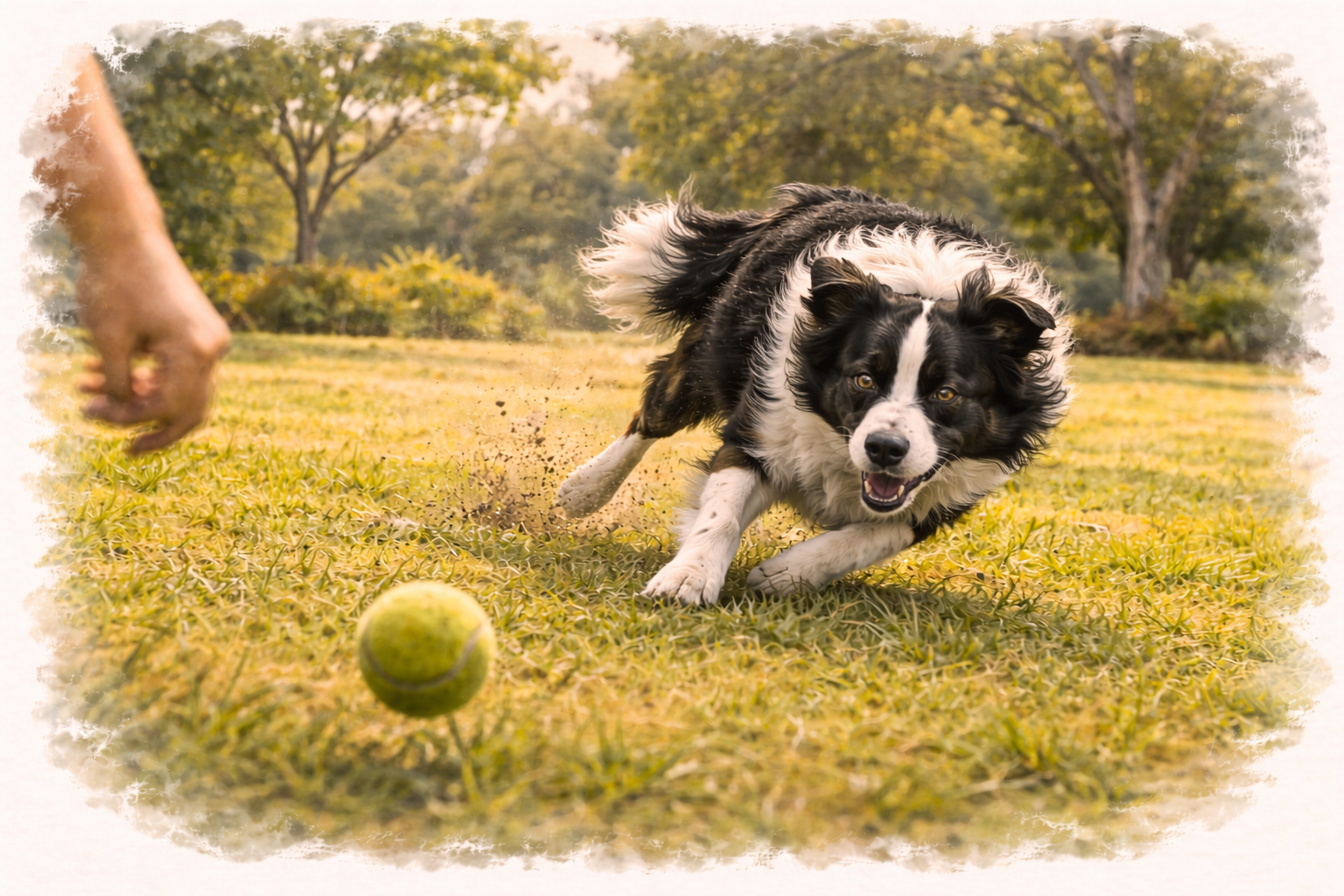
There’s a dog at the park. Ball at their feet, eyes locked on their owner’s hand, whole body vibrating.
Another dog wanders over to say hello. The first dog doesn’t even register them. There is nothing in the world right now except that ball.
Years ago I would have told that owner to take the ball away. That the dog was too obsessed with it and the whole thing needed to stop.
I don’t say that anymore.
The ball isn’t the problem. It’s something the dog genuinely loves, and it’s one of the best tools available for building communication and enriching their life.
The problem is how it gets played. And where.
Compulsion is the thing to watch
What I won’t tell you to do is play in a way that feeds compulsion.
You know the dog. Ball goes out, dog goes after it, dog brings it back and stares. Again. And again. There is no natural stopping point because the dog has no way of finding one.
In my experience that rarely sits on its own. It tends to show up alongside other things.
A dog carrying a lot of stress. A dog who is reactive. A dog who goes from zero to a hundred with no middle gear — no state where they’re stimulated but can still think.
High arousal ball play makes all of those harder, particularly when it happens most days of the week.
The one that gets missed is recovery. A dog whose nervous system is being set off regularly, day after day, isn’t getting the chance to come back down properly. The ball can be a big part of why.
The ten beers
Here’s a way that I explain it to clients.
Going out for a pint isn’t bad for you. A beer with a mate, a glass of wine with dinner. It fills your cup. There’s no hangover from one or two.
That’s a couple of throws in the park. Your dog has a bit of fun and you both move on with the day. Nobody has a problem with that.
Then there’s the dog who gets to the park, starts playing fetch, and cannot stop. Throw it again. Throw it again. That’s not one pint. That’s ten.
I know exactly what that’s like, because I’ve been that guy. Nobody’s saying he isn’t having a great time in the moment. The issue is the hangover, and how badly you handle the ordinary stresses of life the next day.
Do that regularly and at some point it blows up your life.
I’m not even against the occasional big one. If that’s how you let off steam now and then, fair enough. Just pick your moment.
If you’ve got the kids’ dance recital in the morning, or something the next day you need to be sharp for, that’s not the night for ten beers.
Same with your dog. If you’ve got guests coming over, or something coming up you’ll need them to cope with, don’t take them out for a two hour ball session the day before. Especially if they’re already carrying stress.
Residual stress blocks recovery. It makes the hangover worse.
We’ve got a newborn at home. I had a few beers at the weekend — not a crazy amount — and I’m still feeling it this week in a way I simply wouldn’t have before he arrived. Everything else going on around me changed what those drinks cost.
Your dog works the same way.
There’s more to a ball than chasing
Most dogs enjoy acting on some part of the predatory sequence. Seeking something out. Tracking it with their eyes. Stalking. Chasing.
A thrown ball only really taps the chase. That’s one part of a much longer sequence, and it’s the most arousing part.
The ball can do far more than that. It’s also one of the best opportunities you’ll get to practise communication while your dog is genuinely excited.
That’s the real prize. Not a dog who listens in the kitchen. A dog who can still hear you when they’re animated and stimulated and the thing they love most is in play.
Start by asking the dog to think
Ask your dog to wait. A sit, a down, or just holding still. Their movement is anchored before the ball appears.
Then you introduce the ball. How you introduce it decides which part of the sequence you’re engaging.
Walk away, turn around, and throw it back towards them to catch. Now they’re tracking movement coming at them with their eyes. Herding dogs tend to love this one — it hits the tracking and stalking need directly.
Or walk away and simply place the ball on the ground. Take a couple of steps back. Then release them with a word. Go on, mate, go and get it.
That second one is the foundational game and it’s my favourite place to start. The dog isn’t reacting to movement at all. They’re waiting for you.
You can teach the whole thing with a bit of food first if that’s easier. The principle is identical. You wait there. I’ll tell you when.
Three directions from there
Once that foundation holds, I take it three ways.
The first is hiding the ball. Now when they’re released they can’t just run at something they can see. They have to use their nose. That one suits gun dogs and hounds particularly well — dogs who thrive on scenting out the thing they’re after.
The second is my favourite. Ask the dog to wait in one spot. Put the ball down somewhere else. Then move yourself to a third position, so you’ve made a triangle.
The dog is expecting to be sent to the ball. Instead you call them to you.
They come, they get paid — food, praise, interaction — and then you release them to the ball anyway.
That is recall practised under real competition. Your dog knows exactly where they’d rather be, and you’re asking them to choose you instead.
The angle is your dial. Stand almost between them and the ball and they’ll choose you easily. Widen it out and it gets much harder.
The third direction is the movement of the ball itself. Placing it is easiest. Then rolling it. Then an underarm throw. Then overarm.
The more energy in that ball and the faster it moves, the less likely your dog is to hold it together. That’s the point. You’re building up to more stimulation, not avoiding it.
Let them win, and let them lose
Start slow and deliberate. Over time add speed, add unpredictability, move faster yourself. The more chaos you can introduce, the closer it gets to real life.
Eventually you might not ask for a wait at all. Just a glance that says it’s coming, don’t chase it yet. Then throw.
If you stay in safe land — everything slow, everything predictable, no variables — you’ve got a party trick. It won’t hold up anywhere that matters.
So don’t play too safe. I want them to win most of the time, which means sometimes they won’t.
When they don’t, they’re not in trouble. Nothing happens. I just adjust. Close the angle a bit next time. Slow the ball down. Put less energy into it so they’re not quite so hyped.
The dog waits because waiting pays, not because staying put is safer than moving.
And you never push to the point of frustration. The message is simply: hold on a moment and you’ll get your turn.
Dogs played with this way build a genuine love of listening. Listening is how the good thing happens.
What you get out of it
Thinking under high arousal rather than only under low pressure. That transfers to the situations you actually care about.
Healthier emotional regulation. Impulse control built through reward rather than pressure. A much broader slice of the predatory sequence being satisfied than chase alone ever gives them.
There’s a physical argument too. Your vet will thank you. There are an enormous number of ruptured cruciate ligaments out there caused by dogs scrambling and turning erratically after a ball.
A more controlled game reduces that risk. And not just the physical kind — you’re reducing compulsion at the same time.
Your dog ends up thinking as much as they run. That’s more satisfying than pure sprinting, and it builds confidence, because they’re solving something.
They get a bit of agency over the game. Agency builds independence. Independence builds resilience.
Now the bigger one: where you play
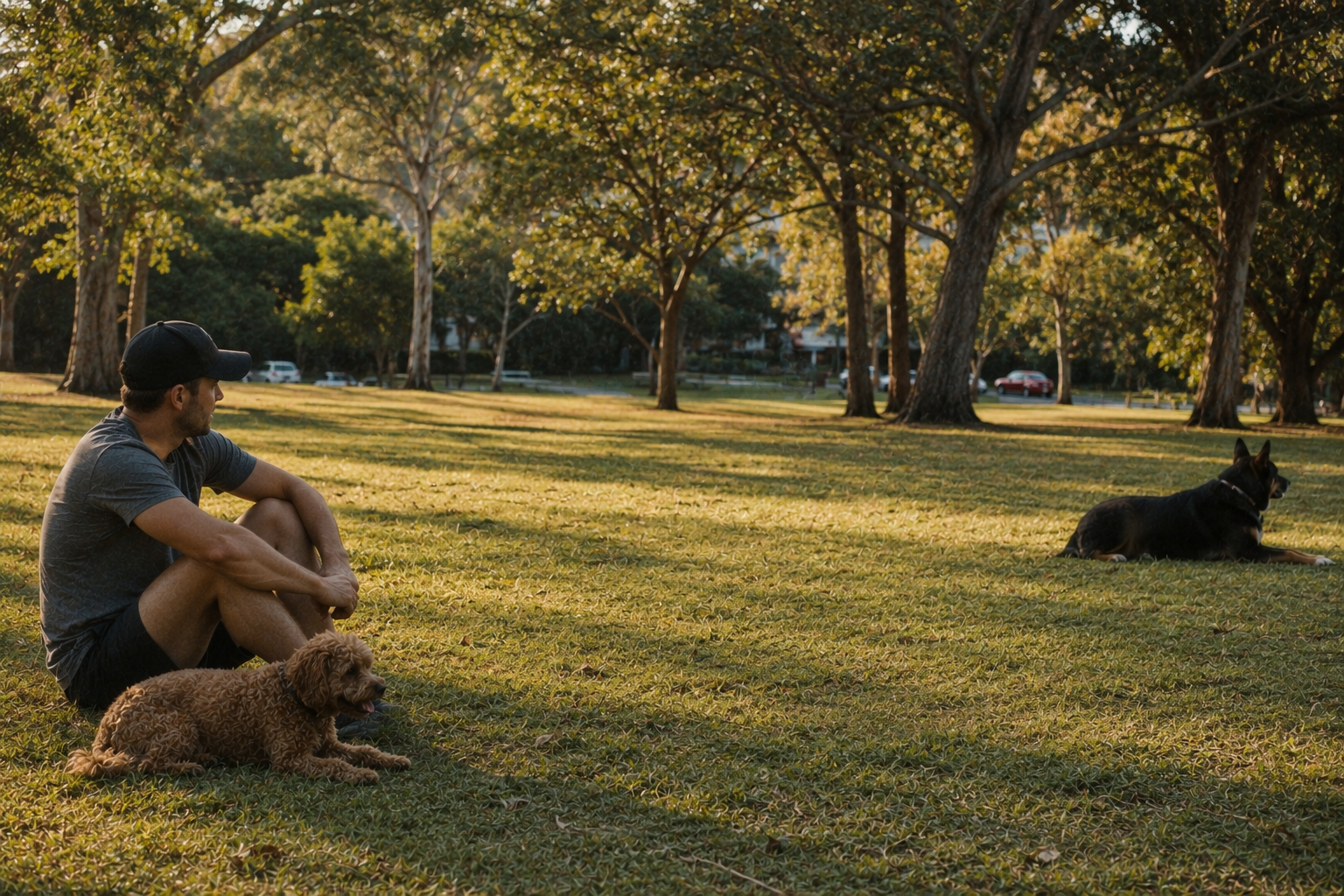
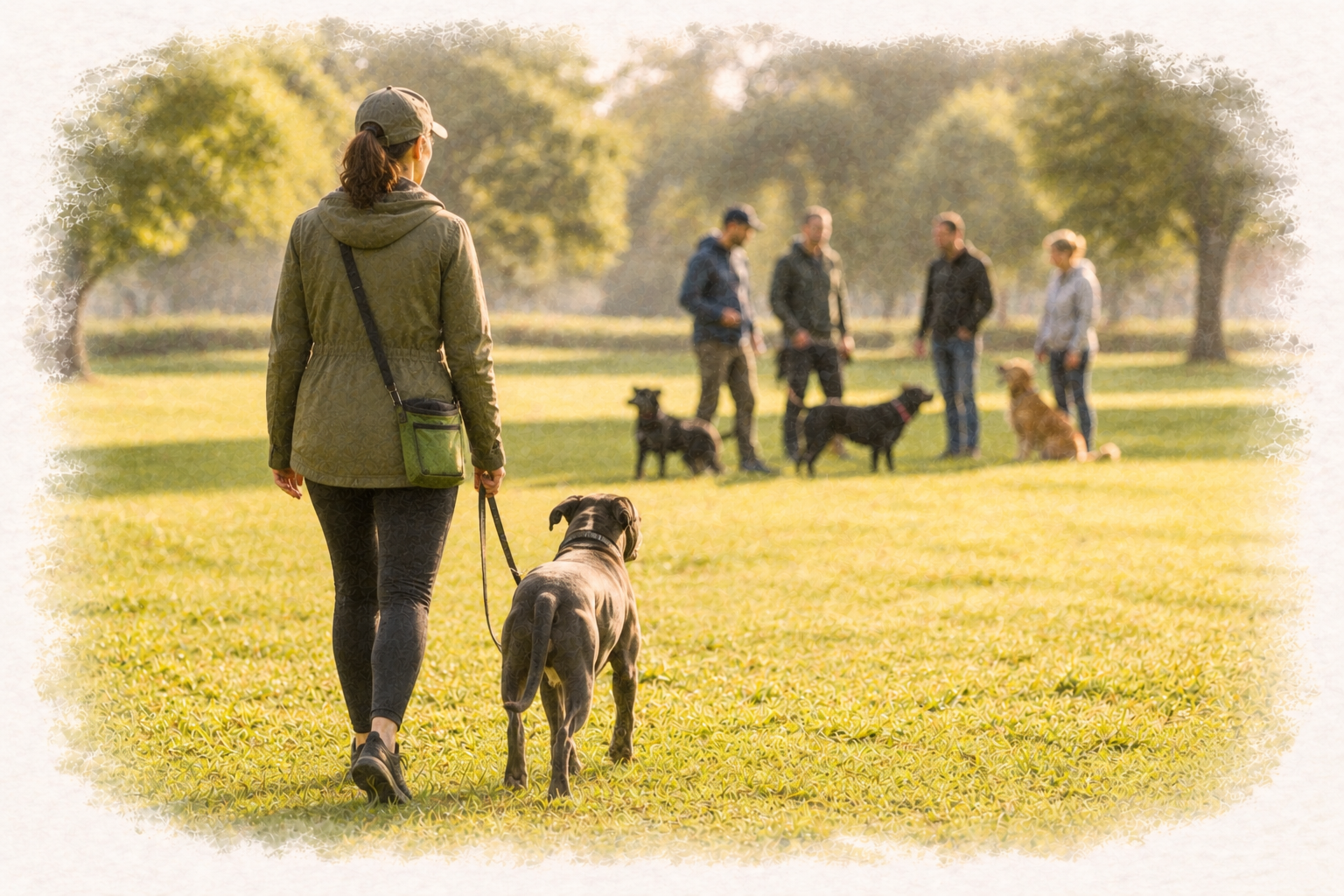
If I arrive at a park and see another dog with a ball or a toy, I leave.
A ball in a shared space is a resource. Resources create the opportunity to guard and protect. And a dog who is hyper-fixated on that ball has told you something important — right now they don’t want to play with dogs, they want to play with the ball.
If my dog goes and gets in the way of that game, there are two possible outcomes. Neither is good.
Either the other dog feels awful because mine has ruined their game. Or mine gets told off in a way he won’t enjoy for exactly the same reason.
So I go home. It costs me nothing and it removes the whole problem.
Why I don’t bring one either
I also wouldn’t take my own ball into a park, for two reasons.
The first is that these are social environments. Dogs are there to be around other dogs. Ball play is a one-player game. In a social space, it’s antisocial behaviour.
If my dog needs a ball as a crutch to cope with being around other dogs, that tells me something. It means the social pressure is too high for him right now.
The answer there isn’t a ball. It’s lower stimulus — fewer dogs, calmer dogs — so he can build real confidence in the interaction rather than leaning on an object to get through it.
The second reason is the state it puts him in.
Good social time needs a coherent dog. They have to be able to hear what other dogs are saying and respond calmly. Ball play takes most dogs somewhere well past that.
If your dog is into balls at all, the odds are they need a high state of arousal to play properly. That’s a bit too spicy for healthy social interaction.
There is a dog who can do both — get wildly stimulated, read everyone accurately, and come back down fast. That dog exists. That dog is a unicorn, and almost certainly isn’t yours. If it is, good on you.
The quiet pub
Picture a quiet pub. People are chatting, having a laugh, a bit of banter. It’s all light.
Then a bucks party walks in. The whole energy changes — loud, boisterous, filling the room.
Everyone there has three options. Sit and tolerate it. Say something about it. Or leave.
That’s ball play arriving at a calm dog park.
When I see that energy coming, I’m out. I don’t want my dog entertaining it, and I don’t want him learning that this is what the park is.
Where it does belong
None of this means don’t play ball. Play ball.
Just save it for places where it doesn’t matter how wild your dog gets. Somewhere the only two participants are you and them.
Structure it so they’re thinking as much as they’re running. Watch what it costs them afterwards and pick your moments accordingly.
The ball was never the problem. It was only ever how, and where.