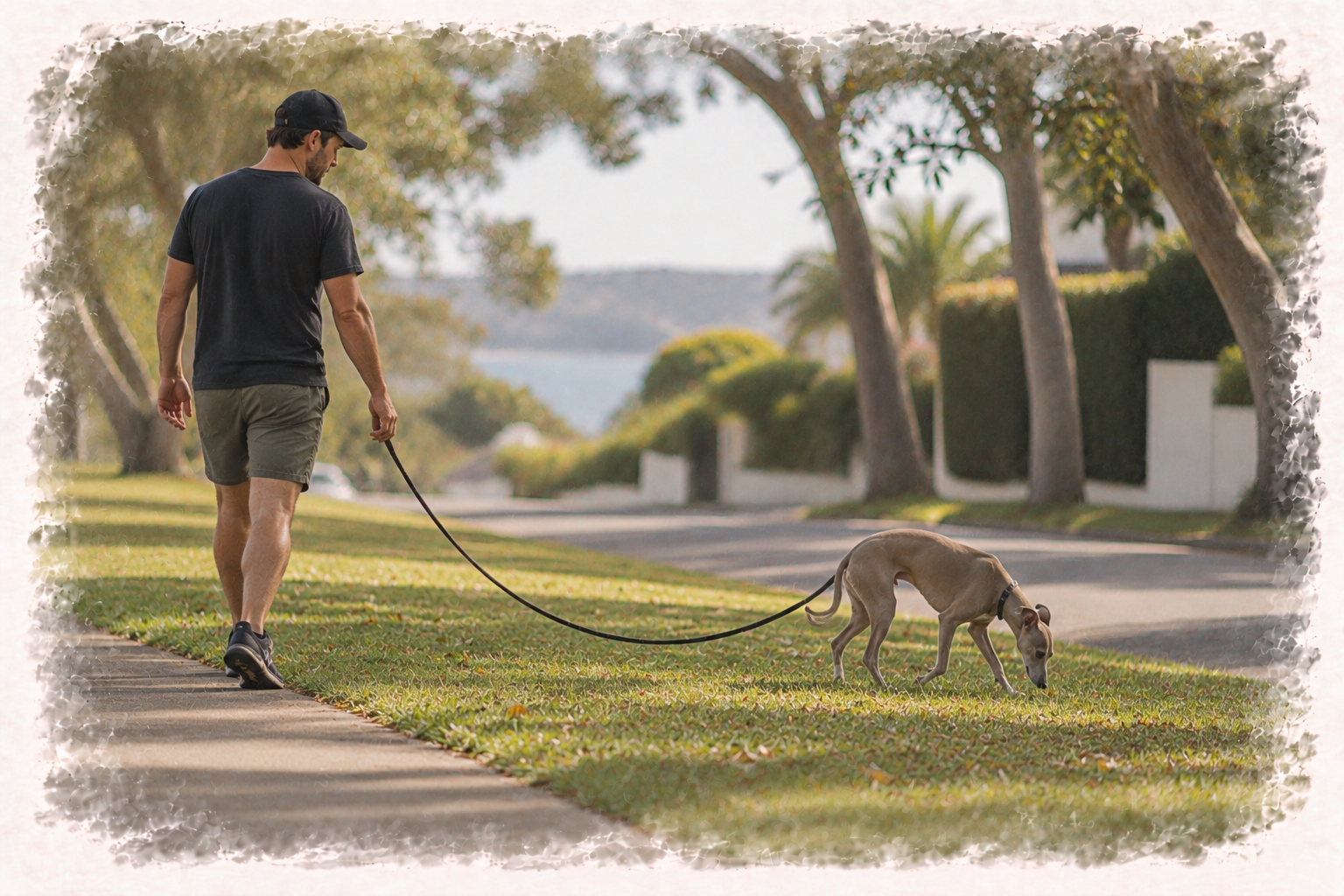
A client’s dog walked down his own street yesterday. The same street he walks every day of his life.
Sitting on a driveway pillar outside one of the houses was a fake black cat.
He lost his mind.
He reacts to cats, so in one sense that is entirely predictable. The problem is there are a lot of fake cats out at the moment. It seems to be the decoration of choice this year.
And Halloween has not happened yet.
The street has already changed
The decorations are up. The kids are excited. The route your dog knows by heart is no longer the route they know by heart.
Fake spiders on fences. Jack-o’-lanterns on steps. Motion-sensor props that fire off as you pass and set a tree shaking at head height.
For a lot of dogs none of this registers. For the sensitive ones, it has already begun.
And the damage isn’t confined to the moment it happens. A dog who gets a fright early in a walk carries that into the rest of it. Their sensitivity is now higher. Their reactions come faster, harder, and more often.
One fake cat on a pillar can colour the next forty minutes.
What happened at the park
We took that same dog to the park afterwards, and a lot of dogs there were fizzy. Everything felt heightened.
Then three dog walkers arrived at the far side at the same time. Same company, by the look of it. Four dogs each, at least.
The noise from that meet and greet rippled through the whole park. It was loud. There was real tension in the barking — some genuine squabbling in there.
And it went on for several minutes, which is a long time for a greeting. Every one of those dogs stayed on lead throughout.
We were a good hundred metres away. Our dog was shook.
He is a sensitive dog anyway, and he had arrived already topped up by the decorations outside his own house. But a hundred metres is a long way for something to reach.
Then it spread
He wasn’t the only one it reached.
A few minutes later there was another altercation, another hundred metres away in a different direction. Then it crescendoed.
Dogs with no involvement in the original incident were now having problems of their own, somewhere else entirely.
We decided to leave. But to leave the park we had to walk through the park, and every single dog we passed on the way out was rattled.
That particular incident had nothing to do with Halloween. The lesson still holds.
One heightened dog changes the temperature around them. A park full of dogs who are already closer to the edge than usual will tip faster, and it will spread further.
Lower your expectations of everyone else too
You control what you expose your own dog to. That part is in your hands and worth taking seriously this week.
But everyone else’s dog is in the same soup.
The dogs you pass this week have also walked past the shaking tree and the cat on the pillar. Their tolerance is lower than it was a fortnight ago.
So expect less social grace from the dogs around you, and give them more room than you normally would.
The knock at the door
Here is what this feels like from the inside, and I’m living it at the moment.
We have a newborn at home and a toddler. If someone knocks on the door in the evening and wakes her up, that is going to annoy me.
But this week something else is happening. I am sitting there in the evening already thinking about it. Please don’t. Come on, don’t wake her.
I don’t do that any other week of the year. And because I am anticipating it, the knock when it comes will land harder than it otherwise would.
Your dog is doing the same thing.
Spooked once, then walking the rest of the week half expecting to be spooked again. That anticipation is its own load, and it is why reactivity climbs this week even on the walks where nothing much happens.
Take your foot off the gas
The fix is unglamorous. A week or two of shorter walks and far less social interaction.
Boring, slow, predictable, low pressure. Nothing asked of them socially while everything else is filling their cup.
That will not be detrimental. Two weeks of quiet walks costs your dog nothing.
Zoom out and picture the two versions of a fortnight from now.
In one, you eased off, gave them downtime, and the batteries never got properly drained. You go back to normal and barely notice the dip.
In the other, you ploughed through. That is the version where, two weeks from now, you are ringing a behaviourist because the behaviour has fallen apart.
You can do something about a known event before it arrives. That is the whole point of knowing it is coming.
The home side of it
Walks are only half of this. Dogs need to sleep, rest and recover, and they need the environment stable enough for the nervous system to regroup.
I notice it in myself. Finish work, get home, do everything family life demands, and if I don’t sleep well, the next day is harder. Dogs are no different.
If the door keeps getting knocked and their nervous system keeps firing, that is another reason to ask less of them.
It is also worth changing what they have access to for a few days.
Can they get to the front door? The front windows, with costumes going past all evening?
If you have a dog who barks at the front of the house, keeping them away from the front of the house is good advice at any time of year. This weekend it is close to essential.
None of this means cancelling Halloween
The kids running around excited is a lovely thing. My daughter turns three on Halloween and she is just starting to get into it.
This is going to happen, and it should happen.
What I’m asking is that your dog is actually ready for it, and supported through it.
Over the next few days there will be fewer opportunities for them to run around at full tilt and have a brilliant time. That is a bit sad, and it is also the reality.
You can push through it anyway and get the run in. But if that costs their mental and emotional health, it is hard to argue it was in their interest.
Hold on for a few days. Let the weekend pass without piling more onto them.
In two weeks you will both be in a better place for it.