Some Conflict Is Normal
I walked into a house last year and watched a dog take a run at someone. Real teeth, real intent. The owner waved it off. “Oh, he does that. It’s fine.”
A fortnight later I sat in a different living room with a woman close to tears. Her dog had grumbled and turned his head away when she leaned in for a cuddle.
She described it as aggression.
Those two calls came in under the same heading. My dog is being aggressive. That is the spectrum I work across, and it is enormous.
Everyone has a different threshold
How much conflict a person can tolerate varies wildly, and it is shaped by things that have nothing to do with dogs.
The household you grew up in. Whether raised voices were normal at your dinner table or a sign something had gone badly wrong.
Your stress levels right now. What else you are carrying this week. How much of your own wellbeing you are inclined to gamble.
Some people are relaxed about risk. Some people have small children in the house and cannot be.
So I get people who are being bitten regularly telling me it is not that bad. And I get people whose feelings are hurt describing it as the worst aggression on earth.
Both are calling the same number.
Safety is not up for debate
Part of my job is listening to the person in front of me. The other part is holding a line they might not want held.
If someone is getting bitten, it does not matter how casually they tell me about it. We are working on that.
Not because I doubt they can handle it. Because one day it might not be them. It might be a visitor, a child, someone who did not know the rules of that house.
Safety comes first every time.
And the hurt feelings matter too
I joke about the aloof dog. I should not dismiss it.
If the relationship you have with your dog is not the one you wanted, that is worth working on. It is a real thing to feel.
But here is the uncomfortable part, and it is the same in every single one of these cases.
You are the one who has to change.
We change our behaviour to get a change in our dog’s behaviour. That is the whole mechanism. And people find it confronting.
They do not want to accommodate a dog who is being annoying. They do not want to be less affectionate or less invasive of their dog’s space, because affection is how they show love.
Sometimes loving them looks like listening to them and giving them room.
We bred these dogs for conflict
Here is the part that gets skipped over almost completely.
An enormous number of the dogs sitting in our living rooms were deliberately bred to handle a degree of conflict. That is not a defect. It was the job.
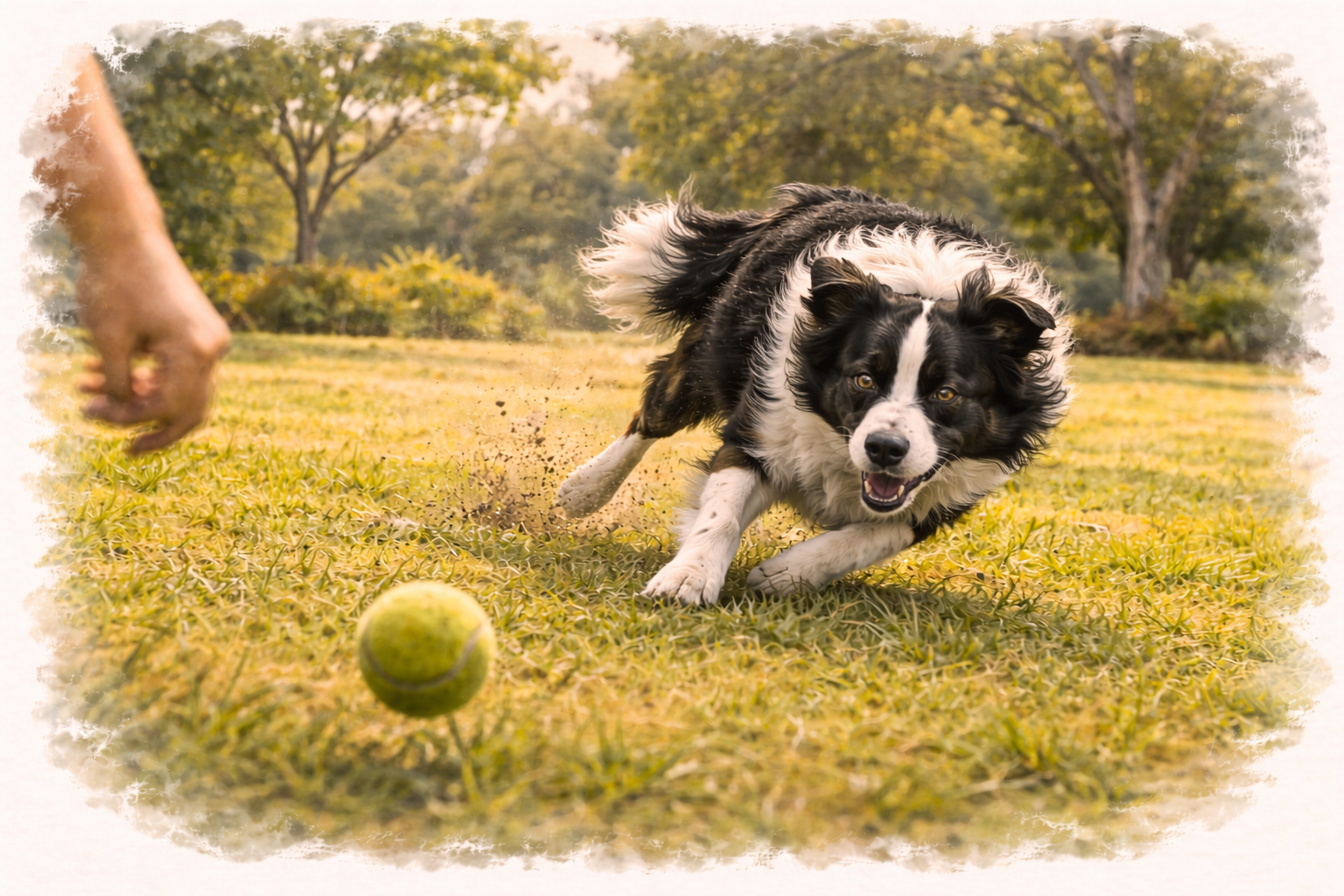
Take the border collie. Beautiful dog, big brown eyes, long slender face. Bred to stare down sheep and control their movement by being confrontational about it.
Herding breeds generally were built to push livestock around. To want control. To persist when things are not going their way.
Nobody was breeding a dog who rolls over and says fair enough, your idea was better. We bred them headstrong. We bred them to push their agenda.
Terriers were bred for hunting, ratting and killing. Nearly every part of the predatory sequence apart from the eating.
Guarding breeds had scepticism bred into them on purpose. A trusting guard dog is not much use as a guard dog. They were designed to be suspicious, and confrontational when the situation called for it.
Hunting dogs were bred to go after living things and push through physical discomfort to finish the job.
So many of our pets are working line dogs. Working means having an agenda. Having an agenda means the occasional bit of conflict.
Arguments happen
So we should probably acknowledge that sometimes there will be arguments. Sometimes voices get raised.
From both species.
To be very clear about what I am not saying: punishment, fear and intimidation are not on the table. I do not agree with any of it. That is not what this is about.
Healthy leadership is not a domineering, micromanaging control freak who loses their temper. That is unstable leadership, and it produces unstable dogs.
What we are aiming for is calmness and consistency. Being disciplined without being disciplinarians. Being able to admit when we got it wrong, adjust, and stay clear about what we are actually trying to do.
Everybody drops the ball
Every one of us has had a moment we are not proud of. And that is us, actively trying to be the best version of ourselves.
We get it wrong sometimes. It happens.
Which means our dogs will too. They are going to mess it up. They are going to make mistakes.
And they are not trying nearly as hard as we are. They do not carry the same moral obligations we do. So of course it happens.
It is still in their interest to communicate well. Dogs are a social species. Survival runs on self-preservation, but thriving runs on the health of the relationships around them.
Most dogs understand at some level that confrontation is not the optimal move.
But under enough stress, or when it is the only thing they have ever learned, that is what comes out. Same as us.
One bad moment, or a pattern?
This is the question that actually matters.
If it happens occasionally, we can usually look at it and say that was a bad day. A bad moment. Nothing to come down on them for.
If it is becoming a pattern, that is worth addressing. Because at minimum two things are going on.
The first is that your dog is communicating an unmet need. Meet the need and the behaviour stops needing to exist.
The second is the pattern itself. If they keep going back to it, something is motivating them to. By definition, it is working for them.
You might think it is a terrible strategy. Whether you think it works is irrelevant. They keep doing it because on some level it pays.
So you break the pattern and you meet the need. Both, together.
Two sides of the same coin
There are two things going on here and they both need saying.
The first is that some of it is normal. Some raised voices, some snapping, some growling, some teeth. In context, that is a dog communicating.
The easiest fix there is usually to stop antagonising them. Do not put them back in that situation.
The second is that sometimes it genuinely is not normal. Sometimes a dog has learned terrible patterns, has no conflict resolution skills, and is becoming dangerous — and underneath it, their needs are not being met.
Those ones need addressing properly.
Questions worth sitting with
There is no clean finish to this one. It is something to think about rather than something to solve.
Next time you see it in your dog, ask whether it is a pattern. Ask whether it is something they have learned works, which means they will keep going back to it.
Or ask whether it was the other thing. Worth noticing. He growled at me, and I can see exactly why.
Some days the honest answer is: I can move a few things around there.
And I earned that growl.