No-Pull Harnesses Don’t Exist
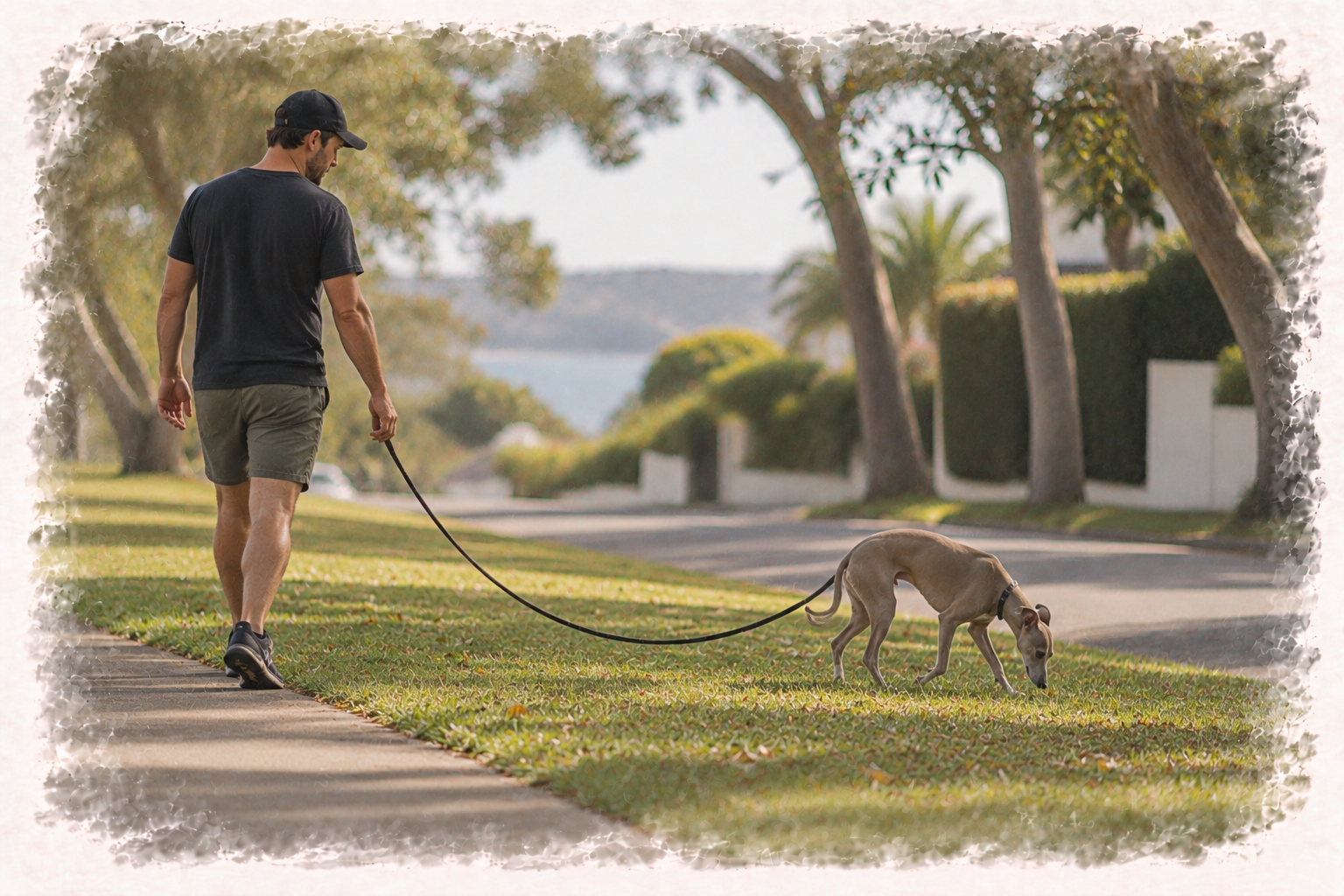
A dog is towing their owner down the footpath. Lead bar-tight, shoulders into it, nose forward.
The owner is talking the whole way. Steady on. Wait. Hey. Wait.
None of it is landing. And the harness that dog is wearing was sold as a no-pull harness.
There is a lot out there on harnesses, and a fair amount of nonsense in it. Some are very good. Some are not. So let me start with the one thing I’d say outright.
The marketing claim to ignore
Harnesses that train your dog not to pull do not exist.
It is a gimmick. It is there to sell you something. A harness cannot train a dog, full stop, and it certainly cannot train one not to pull.
What can happen is that your dog has an unpleasant experience when they pull in it. It pinches. It twists them. It turns them around.
That is not training. That is discomfort.
Training is what teaches a dog not to pull. Nothing you buy does that job for you.
Pressure already means something
Here is the thing I look at first when I meet a new client with a pulling dog.
Wherever that dog has been walked — front harness, back harness, collar, whatever it is — if they have been pulling against it for months, there is a belief system attached to that spot.
They have learned what contact there means.
Usually it means entrapment. Restraint. Frustration. Nothing good.
So when I am training loose lead walking, I will often change where the lead meets the dog. Not because the new spot is magic, but because I don’t want to fight an existing belief system as well as the behaviour.
Why moving the clip helps
Say the dog has been walked on a back harness for a year.
I feel them start to pull, and their first instinct is already loaded. You are about to haul me backwards.
Now I am in a wrestling match on day one. I am not just working on the pulling. I am working against what they already believe is coming.
Move it to a new point and the first few times they feel pressure there, I can release it almost immediately.
Pressure turns out not to mean what they assumed.
And relaxing it buys me something valuable. A window — a short one — where I can actually communicate with them.
A tight lead makes them deaf
Dogs become incoherent when the lead is tight. That matters more than most people realise.
Imagine someone has hold of your T-shirt and is pulling at it while somebody else tries to have a conversation with you.
You are not in that conversation. All you can think about is get off my shirt.
Dogs are no different. You can waste an enormous amount of breath on the back of a dog’s head while the lead is tight.
Soften it first. Then talk.
Front, back or collar
I don’t have a strong preference between types. I don’t have much opposition to any of them either.
What happens in practice is that I move a lot of people from back to front. Not because I love front attachments. Because far fewer people walk on the front to begin with, so it is usually the clean slate.
What I rarely do is move a puller from a back harness to the neck.
A dog who hasn’t learned yet should not be strung up by the neck while they figure it out. The injury risk is real and it does not tend to go well.
On top of that, most people walked the dog on a collar first anyway. That association was often spoiled months before the harness arrived.
When a front attachment is the wrong call
I use them a lot, but they come with a condition. No prolonged pulling.
By prolonged I mean a dog towing you down the street on a tight lead. Two or three seconds is already far too long in my opinion.
If that is happening, address it rather than accommodating it.
With a front attachment you will see it in the spine. They start walking at an angle. Enough of that and you end up with a twisted spine.
I would also avoid one on a really darty dog. The sort who goes from calmly walking to sprinting with no warning. That jolting and twisting is exactly what I want to keep off a spine.
Where a front attachment does earn its place is with bigger dogs. Moving the point forward takes some of the pressure off compared to the back. Not easy. Easier.
Why the back is the worst place for a puller
I very rarely attach between the shoulder blades when I am trying to teach loose lead walking.
Harnesses don’t teach dogs to pull. But if I wanted to build a dog who could pull, that is exactly where I would attach the lead.
It is where all the power is.
The exception is a puppy, or any dog who is a genuine clean slate. There is nothing wrong with a back attachment on a dog who has never learned to lean into one.
At that point it comes down to the individual. Does your dog mind things going over their head? Straps coming underneath? Are they averse to the whole process?
It comes down to you as well. Some people cannot bend over easily, and a fiddly harness is a daily problem rather than a small one.
My own dog walks on a collar with no harness at all. There is no single right answer here.
The part that actually matters
Rather than agonising over which harness to buy, put that effort into loose lead walking.
And start with no lead and no harness at all.
Practise around the house. Practise in the garden. Can your dog walk next to you when nothing is attached to them?
Then, if your dog pulls, work out how to soften that lead as early as you can. That usually means changing your route and going somewhere quieter.
It means taking your dog out on the lead specifically to learn lead walking — not to get somewhere.
Stop doing two jobs at once
While your dog is in that learning phase, separate the training from the exercise.
Put them in the car and drive them somewhere for the actual exercise.
People try to kill two birds with one stone constantly. The walk is meant to tire the dog out and teach lead skills at the same time, and the two jobs collide.
The dog doesn’t get enough exercise, and the lead training is poor as well. Neither gets done properly.
Learn it somewhere it doesn’t count yet
If you know where you eventually want to walk your dog — a collar, say — do the learning somewhere else first.
You are going to be bad at this before you are good at it. Your handling will be clumsy for a while, and that is normal.
Be bad at it on a point you are not going to rely on long term. Probably not the neck, for the reasons above.
Once you both have the skill, you can transfer it to the spot you actually want to use, with no history of pulling attached to it.
Realistically that can take you through puppyhood. Your dog will nail it some days and not others, because they are young and mistakes are part of the deal.
Houdini dogs
Dogs escape harnesses all the time. They reverse straight out of them.
That is dangerous for your dog, and for the car that has to swerve around them.
Some people run two leads for this. Personally I find that cumbersome and annoying. Plenty of people get on with it, but it is not for me.
Here is the simpler version I use.
Get a front attach harness with the clip sitting quite high. Keep the collar a bit loose. Then run your lead through both D rings — the harness ring and the collar ring.
That keeps the harness sitting at the front and stops it sliding forwards or backwards. No reversing out of it.
It also helps with the spine, because the harness stays where it is meant to be rather than twisting around.
Motivate, don’t trap
Whatever you buy, get one that fits your dog properly and one they are not averse to putting on.
Then practise putting it on, as its own small piece of training.
I see the opposite all the time. The dog legs it, the person follows, and eventually corners them and gets the harness on by force.
Don’t do that. It is anti-recall training, and it will make your recall worse every single time.
It is also stressful for a dog who is already avoiding something, and they are usually avoiding it for a reason.
Motivate them into it instead. Make the harness something they walk toward.
The harness is the small decision
Get one that fits. Get one your dog doesn’t mind. Then stop thinking about it.
Don’t buy the promise on the packaging.
Learn to handle a lead, teach the walk, and the equipment becomes almost incidental.