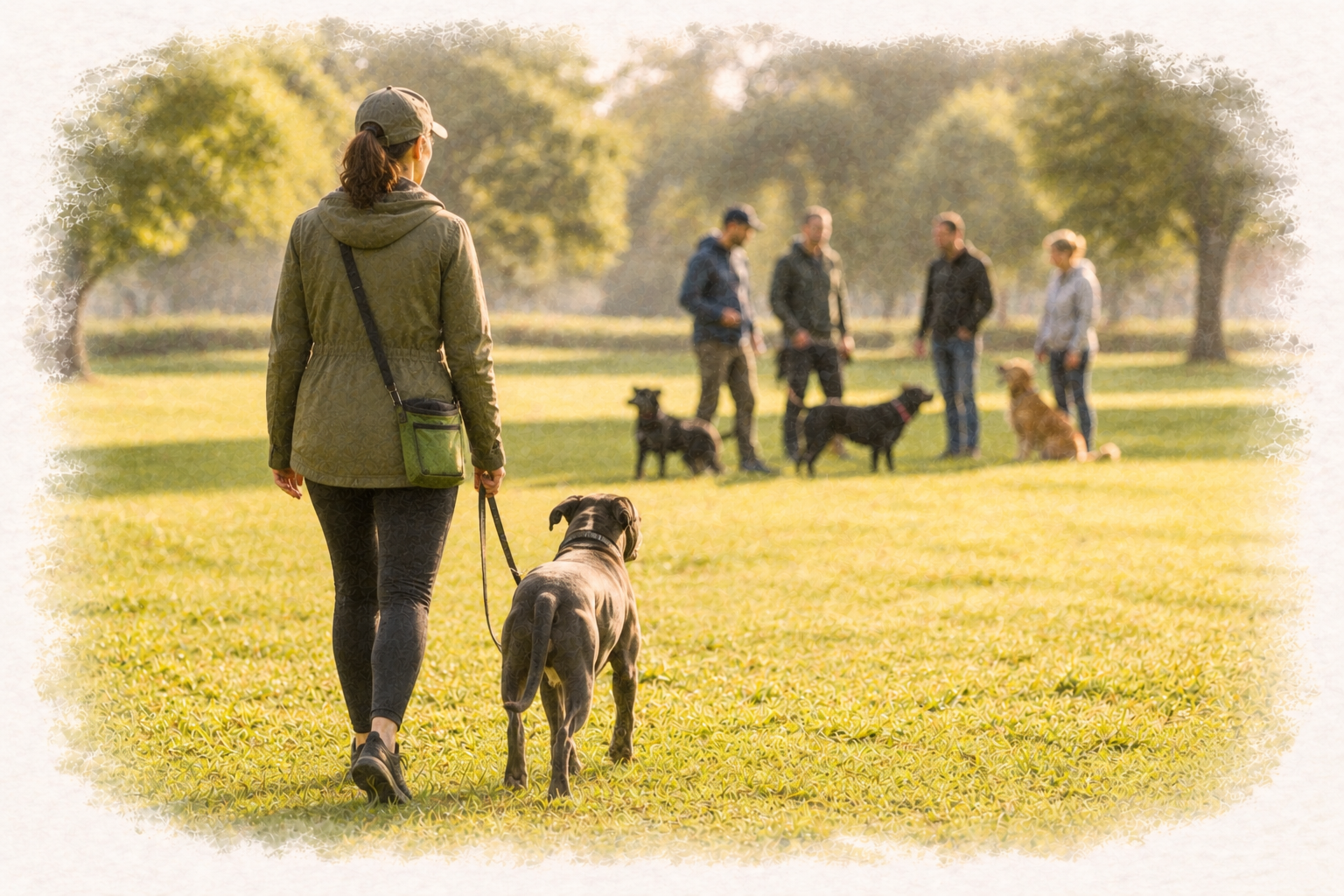
What Healthy Leadership Actually Looks Like
A woman sat in her lounge room and apologised to me for being too soft.
Someone had told her the problem with her dog was that he didn’t respect her. That she needed to be firmer. More assertive. Show him who was in charge.
She had been trying. It had made everything worse, and now she felt like a failure on top of it.
I’ve talked about leadership before, but it has been a couple of years. It’s worth coming back to, because it is one of the most butchered words in this industry.
What the word has come to mean
Say leadership to ten people and you’ll get ten different pictures. It depends on your upbringing and what you already believe.
In dog training specifically, it has been dragged somewhere unhelpful.
The version I hear thrown around goes like this. Your dog doesn’t respect you. You need to be the alpha. You need to be dominant. He has to learn his place in the pack. You have to assert yourself over him.
It’s a macho, chest-out idea of what being in charge means. Ruling through fear and control.
And underneath it sits a message aimed squarely at the owner. Be the assertive, angry one, or you’re not a good dog owner.
That is complete rubbish. It also does real damage to people who are already worried they’re getting it wrong.
Good leadership is strong
Let me be clear about something. I’m not arguing for weak leadership. Good leadership is strong.
It’s calm. It’s clear. It creates clarity rather than confusion. It’s reassuring.
And above all of that, it provides safety. Physical safety and emotional safety, both.
Anyone living under leadership where their safety feels compromised will be flagging. That is true of dogs and it is true of people.
Think about a workplace
Physical safety is the obvious one. If you don’t feel physically safe at work, nothing else matters. Everything stops there.
Emotional safety is less visible and just as real.
Living in fear of losing your job. Being ignored. Being socially frozen out. Someone using relational aggression to get what they want from you.
That is a horrible way to live, and nobody does their best work in it.
Your dog is living in a household with exactly the same dynamics. The leadership on offer decides which version of that they get.
Where the bad version came from
Most of it traces back to dominance theory, which has been comprehensively dismantled.
Dogs are not trying to dominate you. Dominance does not cause unwanted behaviour.
If your dog is doing something you don’t want, it is not because they are making a bid for the top spot. It is not because you failed to be the alpha.
And even if a behaviour did come down to a gap in leadership, that would not license violence, fear or intimidation as the fix. Those two things were never connected.
Disciplined, not a disciplinarian
Healthy leadership means setting clear boundaries and holding them consistently.
It means being disciplined within yourself. What you give your dog access to. When. For how long. Under what conditions.
That is a very different thing to disciplining them.
Your dog’s behaviour is largely a product of the situations and the individuals you put them in and around. You control that. Almost entirely.
It’s on me, not the dog
Here’s how that plays out for me.
I take my dog out. I let him go down a particular path or into a particular space. That was my decision.
If he gets down there and puts on a show, and the behaviour isn’t what I wanted, that is still on me.
He is my responsibility. I chose to bring him into my life. I need to own that.
Part of healthy leadership is that you do not blame those in your care.
If they aren’t meeting the standard you’d like, they are still in your care. You coach them. You teach them. You manage what they get exposed to so they are set up to succeed.
And when they do fail, your job is to make sure that failure isn’t damaging — to them, to you, or to anyone else.
Doing the choosing and then blaming the dog for the outcome doesn’t hold together.
On getting frustrated
I’m not telling you never to get frustrated. I get frustrated.
There are plenty of moments in my own life where I’m angry and not the best version of myself. I get it wrong.
But the frustration almost always comes from the same place. A lack of clarity. Not knowing what to do.
I get stuck, and that’s annoying. Then it gets frightening, because I thought I could handle this and apparently I can’t. And that opens up a whole set of questions in my head.
If I take stock, step away, and talk it through with someone, I can usually resolve it. I can learn something.
If I don’t do that, I get angry instead. But the anger came from fear. Fear of not knowing. Fear of the unknown.
If that happens to me, it happens to my dog too.
We control their variables
Think about how little say your dog has. Where they go. How long for. Who they meet. What they’re exposed to and when.
All of it depends on us. That is a genuinely anxiety-inducing position to be in.
So when we set them up to fail, we aren’t just creating a bad moment. We are raising their baseline anxiety.
We took them there. We opened the door to the frightening thing and let them walk into it. Then we didn’t supervise it properly.
And we make it considerably worse if we then hold them accountable for it and come down on them like a ton of bricks.
That is what I mean by unhealthy leadership.
What to do when it goes wrong
We are all going to make mistakes. We’ll put our dogs in situations we thought they had covered, and they won’t.
The first job is to arrest it. Stop it. Make it safe. Put a lid on it quickly.
Do that deliberately and clearly. But without anger, and without tension.
Once it has stopped and everything is safe, your role changes. Now you make sure everyone is okay.
Start with the dog in your care. Do they need to be taken away from it? Do they need nurturing? Soothing? Do they need to go back in, but with far more support this time?
I can’t answer that for your dog in a blog. Those are the real variables of a real situation. But those are the questions.
Then check on everyone else. Whoever was around, whoever was affected.
Responsibility, not authority
That is what healthy leadership looks like to me. It isn’t authority. It’s responsibility.
It’s being able to look at something that went badly and say three things honestly.
I did not want that to happen. That one is on me.
I’ll do better next time, and right now I’m going to make everything okay.