Your Dog Isn’t “Super Social” — They’re Potentially Socially Anxious

Ian Shivers • November 18, 2025

Share this article

I understand why obedience is so attractive.

(And Why Teaching Them Not to Greet Everyone Is the Kindest Thing You Can Do)

We’ve all heard it:


“My dog loves everyone!”


“They just want to say hi!”


“They’re super friendly — they can’t help themselves!”

But here’s the truth most people never consider:


A dog who needs to greet everyone is rarely a confident, social dog.


More often, they’re a dog who feels socially anxious — a dog seeking information and reassurance because they don’t yet feel safe without it.

A healthy, socially confident dog can greet, but doesn’t need to. A socially anxious dog feels compelled. They can’t disengage. They struggle when prevented. They melt down, pull, whine, bark, or throw tantrums when you try to move them on.


This isn’t friendliness. This is insecurity.


And the most compassionate thing you can do for a dog like this is teach them that it’s okay — and safe — not to greet everyone.


Socially Confident vs. Socially Anxious

Why Allowing Constant Greetings Makes Anxiety Worse

Many owners allow their dog to approach everyone because they think it’s “good socialisation.” But in reality, it does the opposite.


When a dog feels the need to greet everyone, and we allow them to every time:


  • we reinforce the compulsion


  • we increase their anxiety when they can’t greet


  • we create an expectation that access is guaranteed


  • we reduce their ability to cope with frustration


  • we make it harder for them to regulate in stimulating environments


In essence, the dog becomes more dependent, more frantic, and more emotionally unstable.


If everything in the world is a “must say hi,” then the world becomes overwhelming.


Teaching neutrality — the ability to look, assess, and move on — is what actually builds confidence.


The Kindest Thing You Can Teach: “You Don’t Need to Greet Everyone”

This is where the real work begins.


Not punishment.


Not frustration.


Not dragging them away on a tight leash.

But through:


handling skills, spatial awareness, timing of reward and reading body language.

1. Handling Skills

Your dog needs to know that you’ll guide them, not fight them.


You need to understand how to manage a leash safely, relaxing when appropriate and not restraining without compromising the training goal itself.


This means being predictable, calm, and physically competent in how you move around others and handle the leash.

2. Spatial Awareness

Where you stand matters.
How you angle your body matters.
How much distance you give matters.


Your dog will take cues from the space you create, not just the words you say.


3. Body Language (Yours and Theirs)

You must learn:


  • When your dog is escalating


  • When they’re scanning


  • When they’re “locking on”


  • When another dog is giving subtle “no thanks” signals


  • When tension is rising long before your dog reacts


This is emotional literacy — and it’s the foundation of good socialisation.


Yes, It Will Be Hard at First

 - There will be tantrums.
- There will be frustration.
- There will be moments where your dog doesn’t understand why you aren’t letting them go over.

But this is the uncomfortable part of growth. It’s not about “being the boss” — it’s about helping an anxious dog learn emotional independence.

And here’s the payoff:


  • They become calmer around dogs and people.
  • They can walk past others without stress.
  • Their world becomes less overwhelming.
  • Their behaviour becomes more predictable.
  • They feel more comfortable in their own skin.


That’s the goal — not a dog that greets everyone, but a dog that doesn’t need to.


A truly social dog:


  • approaches calmly


  • reads the room


  • respects “no thanks” signals


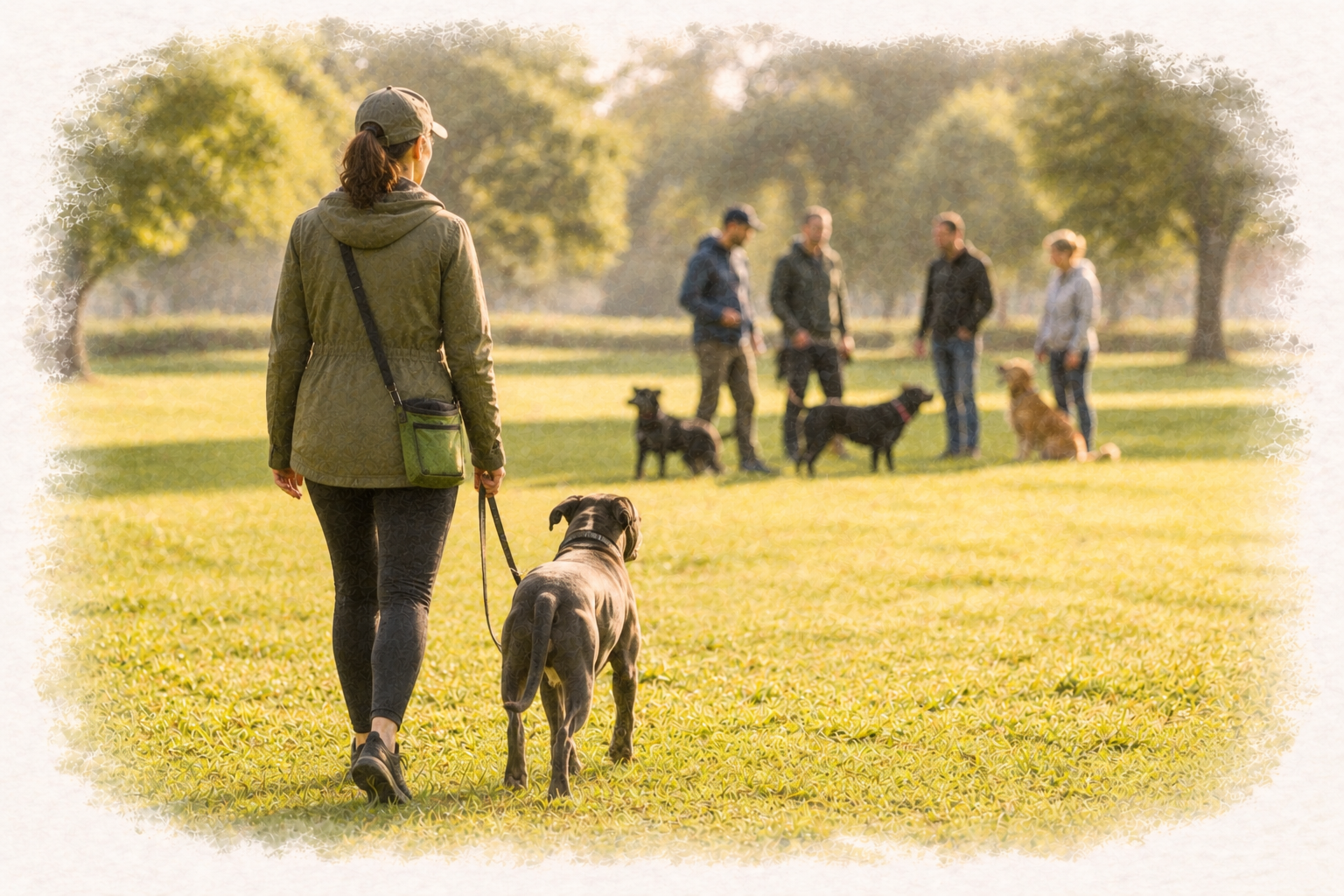
  • is comfortable passing others without interacting


  • doesn’t become distressed if they can’t greet


A socially anxious dog:


  • scans constantly for dogs/people


  • pulls toward everyone


  • can’t hold themselves together when denied


  • becomes frustrated or emotional


  • can’t read other dogs’ signals


  • feels relief only after checking in


What looks like enthusiasm is often emotional dysregulation.


It’s not: “I love everyone!”


It’s: “I need to make sure everything is okay or I don’t feel safe.”


The Takeaway

If your dog feels compelled to greet every dog and person they see, it’s not necessarily a sign of extreme friendliness — it’s likely a sign they don’t feel secure without doing so.

Allowing this compulsion to continue increases anxiety, overstimulation, and frustration.

Teaching them to feel safe in the fact that not everyone must be greeted and self emotional regulation — that it’s okay not to greet — is the kindest, most emotionally supportive thing you can do for them.

Because confidence isn’t created through unlimited access. It’s created through safety, clarity, and emotional regulation.

And in the long run, that’s what gives you a dog who is not only easier to handle — but truly happier within themselves.

The Free Starter Guide includes everything you need to begin making real progress. Hit the button below to get access.

I understand why obedience is so attractive.

Recent Posts

By Bondi Behaviourist April 28, 2026
Most reactive dog advice skips the fundamentals. A Sydney dog behaviourist explains the two skills — leash handling and spatial awareness — that make the biggest difference on walks.
By Bondi Behaviourist April 21, 2026
If your dog barks, lunges or shuts down on walks, this is where to start. A Sydney dog behaviourist explains what's really driving reactivity — and the approach that creates lasting change.
Calm dogs
By Bondi Behaviourist April 9, 2026
Most owners reward excitement without realising it. A Sydney dog behaviourist explains why noticing and protecting calm — rather than interrupting it — is one of the most powerful things you can do for your dog.
Is Your Dog Rushing You at Home? Create Calm, Clear Daily Routines | Dog Training Sydney
By Bondi Behaviourist April 9, 2026
Most puppy training focuses on commands. A Sydney dog behaviourist explains why supporting your puppy's emotional state first makes everything else — the listening, the learning, the calm — fall into place.
By Bondi Behaviourist April 8, 2026
When dogs rush you through daily routines it's not naughtiness — it's a lack of clarity. A Sydney dog trainer explains how working dogs think, and how simple structure creates calm involvement at home.
By Bondi Behaviourist April 1, 2026
Letting your dog sleep on the bed isn't a dominance issue or a training failure. A Sydney dog behaviourist explains when it works, when it doesn't, and why the decision is simpler than you think.
By Bondi Behaviourist March 24, 2026
Trying to make every walk perfect puts pressure on you and your dog. A Sydney dog trainer explains why balance over time — not perfection every outing — creates calmer, more enjoyable walks.
dog training ace freework
By Bondi Behaviourist March 19, 2026
Aggression isn't bad behaviour — it's communication. A Sydney dog behaviourist explains what unmet need is driving your dog's reactivity, and why addressing that changes everything.
By Bondi Behaviourist March 12, 2026
Exhausting your dog isn't the goal — a dog that collapses from overstimulation isn't the same as one that's genuinely calm. A Sydney dog behaviourist explains why, and what to aim for instead.
By Ian Shivers February 24, 2026
I understand why obedience is so attractive.
Show More