What Your Dog Is Telling You Before It Reacts
By the time your dog lunges, they have already said a lot.
The lunge feels sudden. It rarely is. There is almost always a sequence of signals that came before it — signals the dog was sending clearly, to anyone who knew what to look for.
Learning to read those signals is one of the most useful things you can do for a reactive dog. Not because it will stop the reaction on its own. But because it gives you something far more valuable than a training technique.
It gives you time.
Your Dog Is Already Communicating
Dogs are communicating constantly. Most of it is subtle. A shift in weight. A stillness that wasn’t there a moment ago. Eyes that go hard. A mouth that closes.
These are not random. They are a language. And like any language, it can be learned.
The signals that come before a reaction are sometimes called stress indicators or early warning signs. They are the dog’s way of communicating that something in its environment is causing discomfort — before that discomfort reaches a point where the body takes over.
Common ones include a stiffening of the body, a hard fixed stare, ears that come forward or flatten back, hackles rising along the spine, a tail that goes rigid, panting that stops suddenly, or a dog that freezes mid-movement.
There are also subtler cues. A dog that suddenly becomes very interested in the ground. A dog that yawns at a strange moment. A dog that shakes off as if wet when it isn’t. These are displacement behaviours — the dog is trying to manage its own stress and telling you it’s struggling.
Most owners learn their dog’s signals over time without realising it. They develop a sense that something is ‘off’ before anything visible happens. That sense is real. It’s built from observing these cues, even unconsciously.
Making that reading conscious and deliberate is what changes how you respond.
Why Reading Your Dog Changes Everything
When you can see the early signals, you can act before the reaction.
That matters because a dog in the early stages of stress is still accessible. It can still hear you. It can still make choices. It can still be redirected, given more space, or moved away from the trigger before its nervous system locks in.
A dog that has already crossed its threshold cannot. Once the reaction is happening, the thinking part of the brain has essentially gone offline. The dog is operating on instinct and adrenaline. No amount of instruction will reach it in that moment.
This is why the lunge feels like it comes from nowhere. It’s not that the signals weren’t there. It’s that by the time the owner noticed something was wrong, the window had already closed.
Reading your dog earlier keeps that window open longer. It means more opportunities to make a different choice — for both of you.
The Other Dog Matters Too
Here is something that most reactive dog advice misses entirely.
Not all dogs your dog encounters on a walk are the same trigger. The dog coming toward you is not just ‘a dog.’ It is a specific dog, with a specific body language, moving in a specific way. And those specifics change everything about how your dog is going to respond.
A dog that moves slowly and predictably in a straight line is a fundamentally different experience for your dog than one that is bouncing, lunging at the end of its lead, and scanning everything around it. Your dog knows this. It is already reading that incoming dog before you’ve consciously registered anything.
Learning to read the other dog gives you the same information your dog already has — and it lets you make better decisions about space, timing, and approach before your dog has to make its own decision for you.
What to Look for in the Other Dog
Eye contact is one of the clearest signals. A dog that is staring directly at your dog is communicating something intense. In dog language, a hard direct stare is a challenge or a threat. It is not neutral. A dog that is aloof, looking around, or deliberately avoiding eye contact is communicating something very different. Your dog will respond to those two dogs in very different ways.
Movement matters. A dog moving at speed, or erratically, or in sudden bursts, is harder for most reactive dogs to handle than one moving calmly and predictably. The unpredictability activates the threat-monitoring part of the brain. Calm, steady movement is easier to process and less likely to trigger a response.
Tension on the lead matters. A dog that is straining forward, chest low, pulling hard toward your dog is communicating high arousal and intent. That’s a very different signal to a dog that is trotting loosely beside its owner.
Where the dog’s attention is matters. A dog that is fixated on your dog, locked on, tracking every movement — that dog is already in a heightened state. A dog that is sniffing the ground, glancing around, checking in with its owner — that dog is more relaxed and less likely to create a difficult encounter.
One of the subtler cues is a dog that keeps looking up at its owner. That behaviour often signals anxiety. The dog is checking in because it is uncomfortable. It is looking for reassurance. That dog is already stressed by the encounter, and a stressed dog is more likely to produce a stress response in yours.
When you see a dog doing that — repeatedly glancing up, unsettled, seeking its owner — the right move is usually to create more space, not less. That dog has already communicated that the proximity is too much.
Two Skills, One Walk
Reading your own dog and reading the incoming dog are two separate skills. Both matter. Together they change the walk.
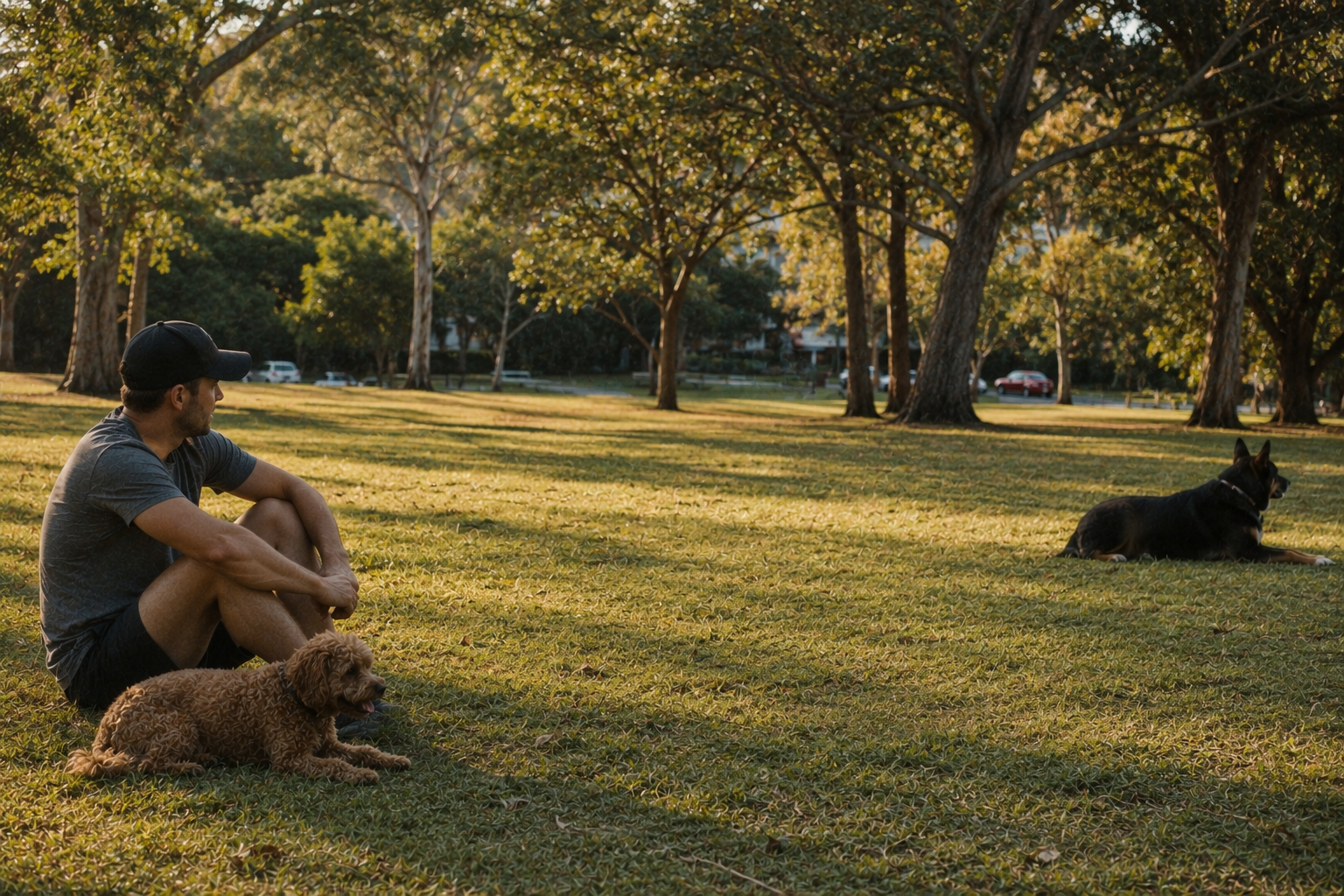
When you can see your dog beginning to tighten, and at the same time assess that the dog ahead is staring, pulling, and moving erratically — you have everything you need to make a good decision. You know your dog’s state. You know what the incoming dog is communicating. You can act on that information before anyone reaches their limit.
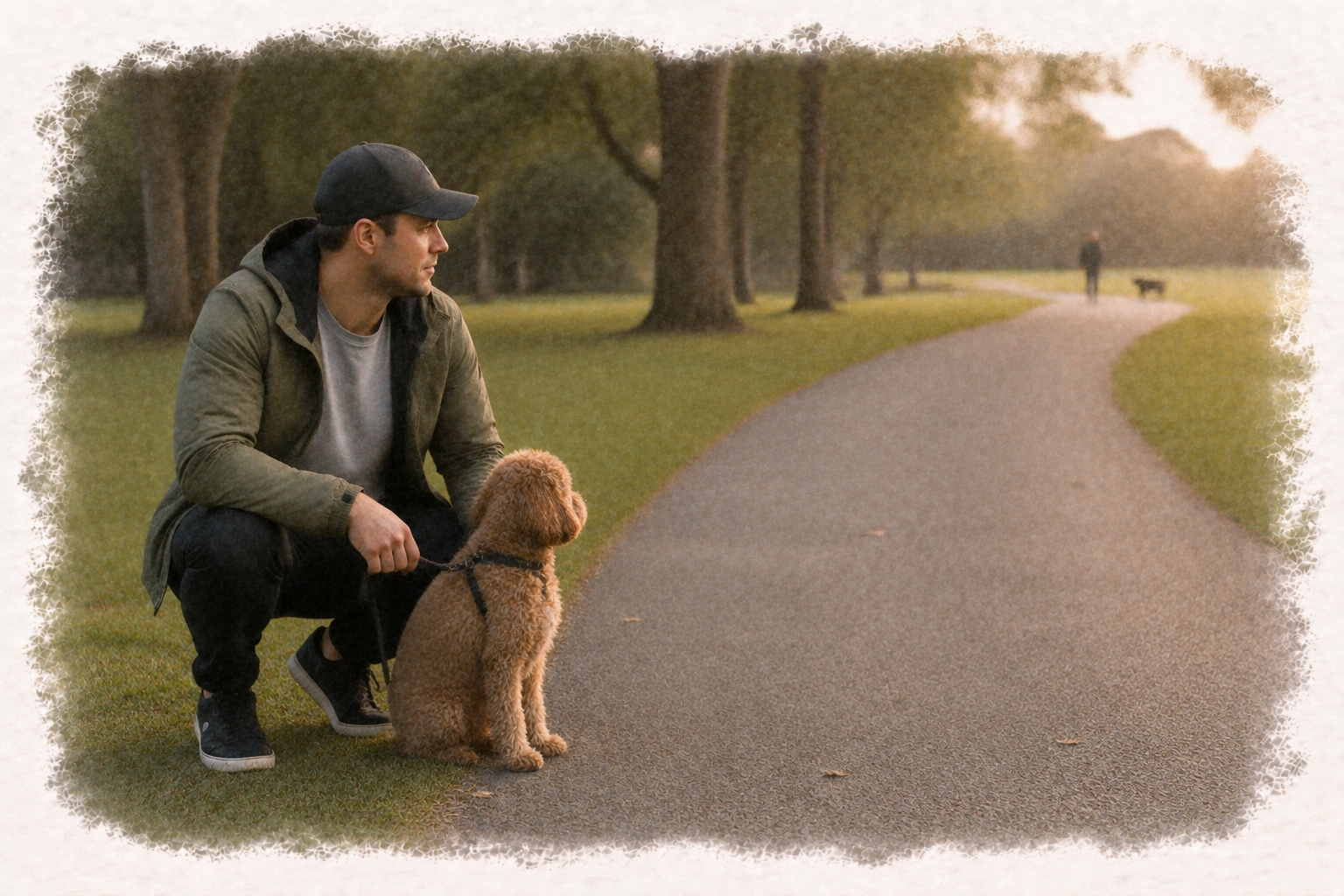
That might mean crossing the street earlier than you usually would. It might mean stopping and letting the other dog pass with more distance. It might mean turning and going the other way. It might mean holding still and waiting.
The decision changes depending on what you’re reading. And the more accurately you can read it, the better the decision will be.
It Gets Easier
This is a skill, not a talent. It improves with attention and practice.
Most people start by recognising their dog’s signals in hindsight — after the reaction, when they replay what happened. That is still useful. Over time, the recognition moves earlier. You start catching signals mid-sequence. Then at the beginning. Then before the sequence has fully started.
The same happens with reading other dogs. At first it feels like too much to process. With practice it becomes quick. A glance at the incoming dog tells you most of what you need to know.
The walk gets quieter not because the triggers disappear. But because you can see them coming earlier, and you know what to do with that information.