If Your Dog Is 100 Metres Ahead of You, You’ve Already Lost Control
I was in the park recently. I watched a dog take off across the grass toward a group of other dogs.
Their owner was about 100 metres behind. Ambling along. Phone in hand.
I know how that looks from the outside. It looks relaxed. It looks like a dog enjoying freedom. It looks like an owner who trusts their dog.
I want to be clear about what I’m talking about here. Every owner has had a moment where their dog got further away than planned. A squirrel. A gate left open. A lead that slipped. That happens. It’s not what this is about.
What I watched in the park was different. This wasn’t an accident. It was a habit. The owner’s pace, their distance, their attention — none of it suggested a moment that had gotten away from them. It suggested this was simply how they walked their dog. Every day. As a matter of course.
That’s the difference worth talking about. An accident is a moment. A habit is a pattern. And it’s the pattern that creates the conditions for something to go wrong — not the occasional slip that happens to even the most careful owner.
What it actually is, is an owner who has handed over every decision to their dog and removed themselves from the equation entirely.
I’ve seen this go wrong more times than I can count. And when it goes wrong, the owner is never close enough to do anything about it.
You don’t know what’s in that group
A group of dogs in a park is not a safe, predictable social environment. It is a collection of unknown animals with unknown histories, unknown triggers, and unknown thresholds.
You don’t know which dogs are in there. You don’t know which dogs might enter while your dog is heading over.
You don’t know whether any of them have had a bad morning, a stressful week, or a nervous system that is already running close to its limit.
Your dog doesn’t know these things either. But your dog is also not able to assess the situation with any perspective. They are operating on instinct and momentum. They are running in because they want to. Not because they have assessed the group and decided it is safe.
That assessment is your job. And you cannot do it from 100 metres away.
The two ways it goes wrong
There are two potential issues with this scenario. Both are a problem.
The first is that your dog is the one who causes the issue. A dog running at full speed toward a group of unknown dogs is not sending a calm, polite signal. They are arriving fast, uninvited, and at high arousal. That is threatening to some dogs. It is rude to others. The dogs already there did not ask for this. Some of them will respond.
You are 100 metres away. You cannot get there in time.
The second is that your dog is the one who becomes the victim. Maybe the group has a dog who is reactive. Maybe one dog in the group is having a bad day. Maybe your dog reads the situation wrong and responds in a way that escalates things. Maybe your dog is more anxious than you realised and being suddenly surrounded is too much.
You are 100 metres away. You cannot get there in time.
In both scenarios, the outcome is the same. Something happens that you could not prevent and cannot quickly resolve. The difference between a moment that passes and a moment that becomes an incident is almost always proximity and timing. Two things that disappear the moment you let your dog run that far ahead.
Your dog being friendly does not make this safe
This is the version of the story I hear most often after something goes wrong.
“But my dog is so friendly. They just want to say hi.”
Friendliness is not the relevant variable. The relevant variable is whether the other dogs want to be greeted, and whether your dog’s energy when arriving is something those dogs can handle.
A large (any size), excitable dog arriving at speed is a stressful experience for many dogs — regardless of the arriving dog’s intentions. Dogs that are anxious, reactive, elderly, in pain, or simply introverted do not want to be charged at by an enthusiastic stranger. They will communicate that. And if that communication is ignored — which it often is when the arriving dog is too wound up to read it — the next communication will be louder.
A friendly dog can still be the cause of a dog fight. Friendliness and good social skills are different things.
What being present actually means
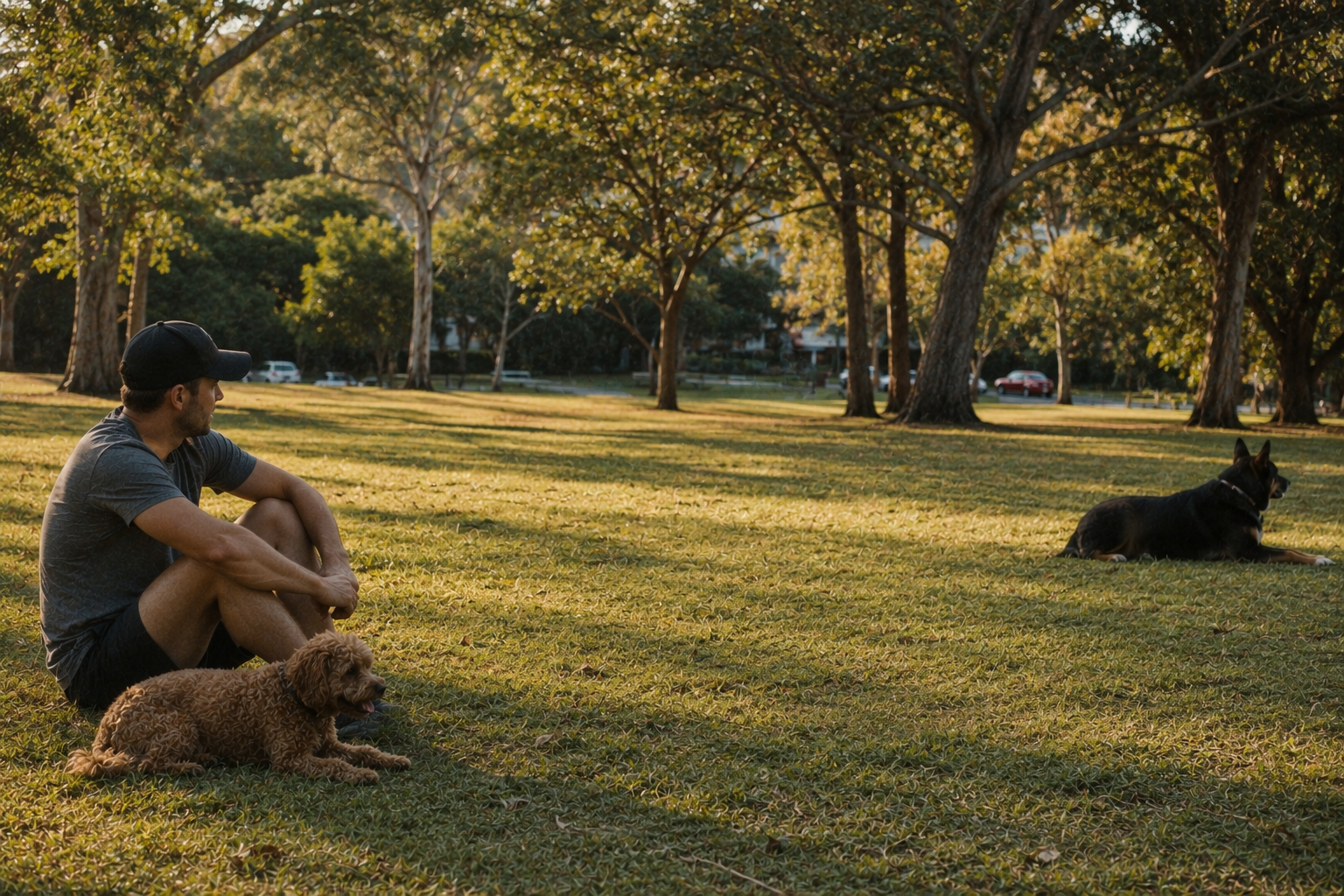
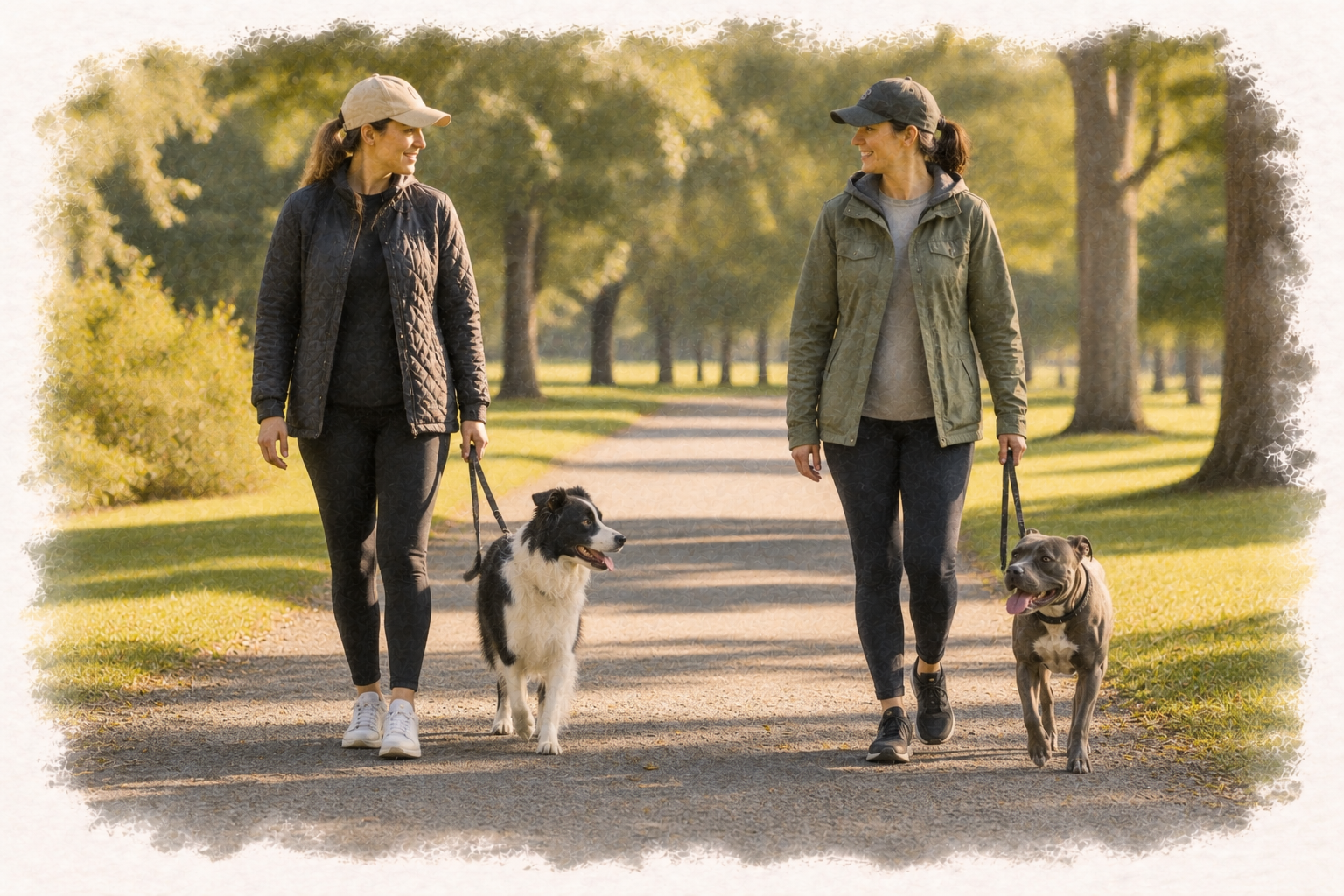
Being present with your dog in a social environment does not mean having them on a tight lead at all times. It means being close enough to read the situation before your dog is already in it.
It means being able to see the group before your dog reaches them. To assess the energy. To notice if there’s a dog in there that looks tense, or one that is already in a state of heightened arousal. To make the decision about whether your dog goes in at all, and if so, how.
It means being close enough to interrupt early if something starts to escalate. Not close enough to stop a bite after it has already happened. Close enough to read the signals before the escalation begins.
It means your dog knowing you are there. A dog who has run 100 metres ahead of their owner is operating without a social anchor. They are making all their own decisions in an environment that may be genuinely unpredictable. Some dogs handle that fine. Many do not. And the ones who do not are the ones you find out about afterwards.
The owner is the variable
Dog encounters go better when owners are engaged. That is not an opinion. It is something I see consistently in practice.
An owner who is present — who is watching, who is moving with their dog, who is aware of the environment — can make small adjustments that prevent large problems. They can slow their dog’s approach. They can redirect before the threshold is crossed. They can choose a different route if the group doesn’t look right. They can call their dog back before the moment tips.
An owner 100 metres behind cannot do any of those things. They can only watch. And then deal with whatever happened.
Ownership is not just feeding and walking. In social environments, it means being the one making the decisions — not handing that job to the dog and hoping for the best.
This is not about restricting your dog
Off-lead time matters. Social time matters. Dogs need the opportunity to move freely and interact with other dogs. This is not an argument against any of that.
It is an argument for being there when it happens.
A dog who plays with other dogs while their owner is close by, paying attention, and ready to intervene if needed — that dog is having a genuinely safe social experience. The freedom is real. The safety net is also real.
A dog who runs ahead into an unknown group while their owner is far behind is not having more freedom. They are having unsupervised exposure to an unpredictable environment. Those are different things.
The best social experiences for dogs happen when the owner is present enough to make them good. Not watching from a distance and hoping.