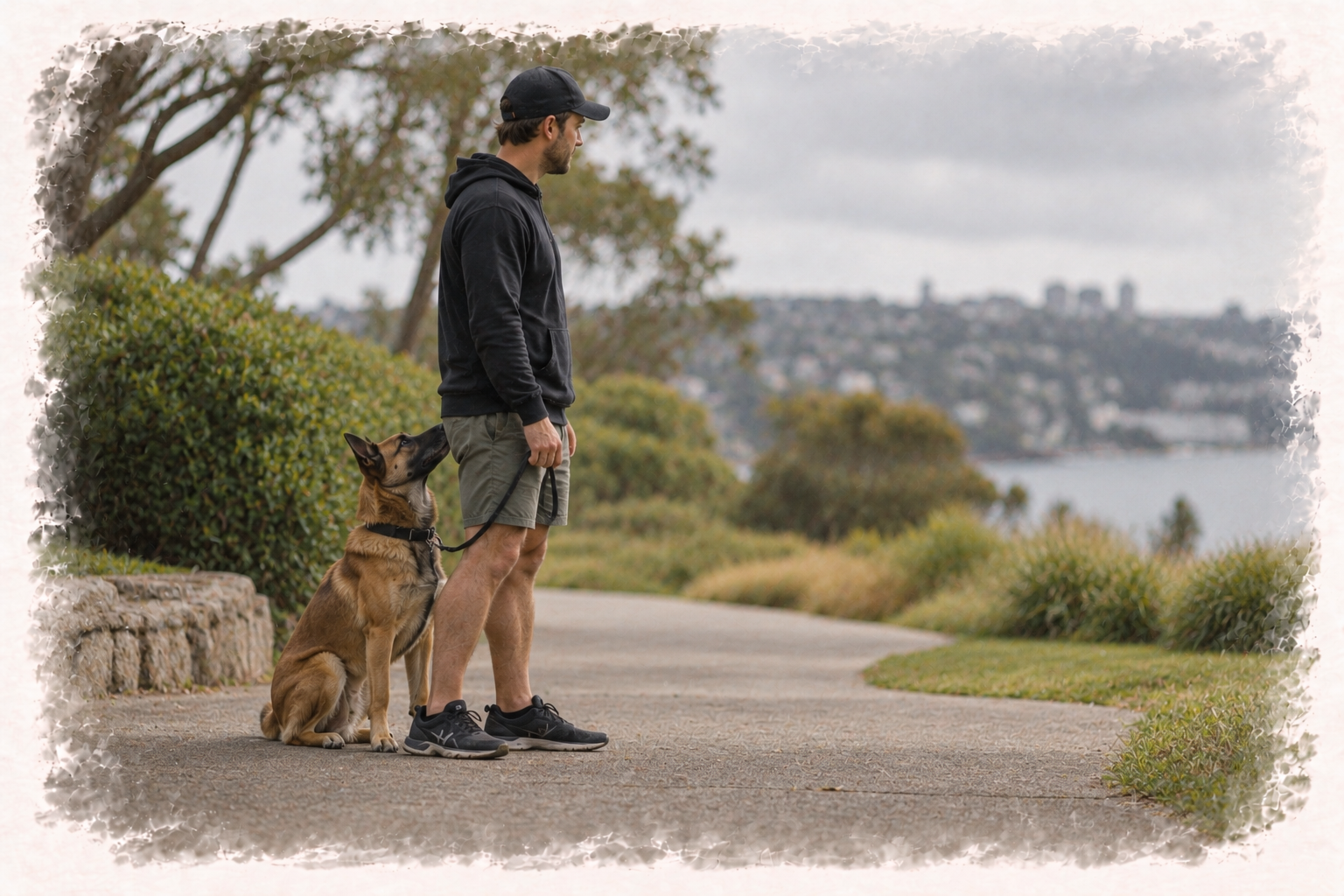
A woman stands in a park throwing a ball. Her dog brings it back, drops it, and stares at her hand.
She throws it again. Forty minutes of that, and the two of them have barely interacted.
She would tell you she plays with her dog every day. What is actually happening is that she is operating a machine the dog is addicted to.
I have covered the compulsion side of that recently, so I won’t go over it again here. What I want to talk about is the thing most people are missing instead.
Genuine, interactive play. You and your dog, actually playing with each other.
What I mean by play
Games that are fun for the dog, not just convenient for the human.
Play where your dog stays engaged with you rather than with an object. Where the communication between you is part of the game.
And play you can switch off when you decide the game is done.
That last part matters. If you cannot end it, it has stopped being a game.
You learn your dog by playing with them
The more you play, the better you know them.
Their mannerisms. Their movements. And the movement before the movement — the way they shift their weight backwards just before they go forwards.
I know my own dog is about to launch before he launches. I know that if he is going one way, he rocks back the other way first.
I know that because I have watched it hundreds of times in games, in a context where nothing was at stake.
Out in the real world, that is worth a lot. I am half a second ahead of him instead of half a second behind.
The better you know your dog, the better you can look after them.
A game is a conversation
Healthy play keeps both parties engaged. It is a back and forth.
Invite. Back off. Slow down. Let’s go. Invite again.
You are constantly deciding whether the game accelerates or decelerates, and so is your dog. That is a conversation between two individuals.
Throwing a ball over and over involves almost none of that. Which is part of why I am not a fan of it as a dog’s whole experience of play.
So I like tug of war. I like games that are just hands — the two of you dancing around each other a bit.
Layering a toy in properly
When I do bring a toy in, I want layers of communication in it.
Come and get it while I am holding it. Now pause while I am holding it. Now pause while I am moving it.
Don’t chase it yet. Then a verbal release to go.
If I put it on the ground, can you still leave it? If I roll it? If I bounce it? If I throw it properly?
Every one of those gets a verbal cue for what I would like them to do while it is happening.
Think about what that builds. Something your dog badly wants is moving fast, bouncing, out of your hands — and you can say, I know it’s there, mate, leave it.
And they are happy to. That is a serious communication skill, built inside something they enjoy.
When you lose a round
Here is the part that keeps it a game.
If I get it wrong and my dog takes the thing I asked him to leave, he does not get punished for it.
I lost that one. That is information for me.
So how do I win the next one? Do I slow it down? Communicate more clearly? Communicate earlier? Make myself more interesting than the toy?
Those are my variables to solve, so the game is enjoyable for me as well as for him.
Which is what a game is supposed to be. Enjoyable for everyone playing. If it stops being that, we stop.
Practising while their brain is hot
Play and movement take a dog into a high state of arousal. That is the point of it.
And the higher the arousal, the lower their ability to think. They process information poorly. They get flustered. They get distracted and go off on their own. They don’t hear you as clearly.
Asking a stimulated dog to do something is much harder than asking a calm one.
A game lets you control exactly how much arousal is in the room.
If your dog tips over into not being able to think, you tailor it. The pace. The randomness. How predictable or unpredictable you make it.
You adjust those variables so they can succeed, rather than just blowing their brain up and calling it exercise.
Then build it. Because out in the world, there are moving things and stimulating places, and your dog’s behaviour is least predictable at exactly the moment you need it most.
A dog who has practised listening to you while their brain is hot handles that moment differently. Yeah, fine, I know this feeling. I’m used to hearing you like this.
Changing what a racing heart means
This one matters enormously for the anxious dogs I see.
An elevated heart rate is part of what anxiety feels like. For some dogs it is the main thing they know that feeling as.
Play, done well, is pleasant. Enjoyable. And it raises the heart rate too.
So you can start to shift what that sensation means to them. They have now felt their heart go up while having a brilliant time.
I have watched dogs move from pessimistic to optimistic on the back of this.
A racing heart stops automatically meaning fear and unpredictability. It can also mean fun, excitement and connection.
The dial
There is an analogy I came across recently that I keep using, because it explains something I see constantly.
Picture a dial from nought to a hundred.
Plenty of dogs are good from nought to twenty. Sleepy, relaxed, settled. Get a dog to rest properly and that is wonderful.
Plenty of dogs are also very well practised between eighty and a hundred. They are experts at being completely bonkers.
It is the middle they are hopeless at. Everything between twenty and eighty.
Games let you work the whole dial. Take them to forty, then bring them down. Sixty, then down. Seventy, then down. All the way up, then down again.
It works like training a muscle. The more you flex it, the stronger it gets — provided there is rest and recovery around it.
Which, incidentally, is exactly why compulsive play does the opposite. All flex, no recovery.
Putting the comedown on a word
What you are really building is a dog who can go up and then regulate themselves back down.
And you can attach a word to it.
When I am playing chase-the-toy with my dog, I say wait. Then I let him decompress. He slows, he stops for a moment, and then good boy, reward, and we go again.
What he has actually practised there is hearing one word and translating it into: slow down, breathe.
That is about as transferable a skill as exists. A dog who has rehearsed coming down from seventy in the backyard has something to draw on when the world winds them up.
And the obvious one
It is fun. Dogs enjoy it.
Bring more joy into your dog’s life and their stress levels come down. That is not sentimental, it is just true.
None of which means making the whole day stimulating. Have a context cue for when a game starts, whether you start it or your dog does.
And be sensible about whether now is the moment. You are either building a good life habit or a poor one every time you answer that question.
We want dogs who have fun, enjoy their lives, carry less stress and bounce back more easily.
And the more playful we are with them, the more both of us laugh things off and get on with it.
So play with your dog more. And play with them properly.